

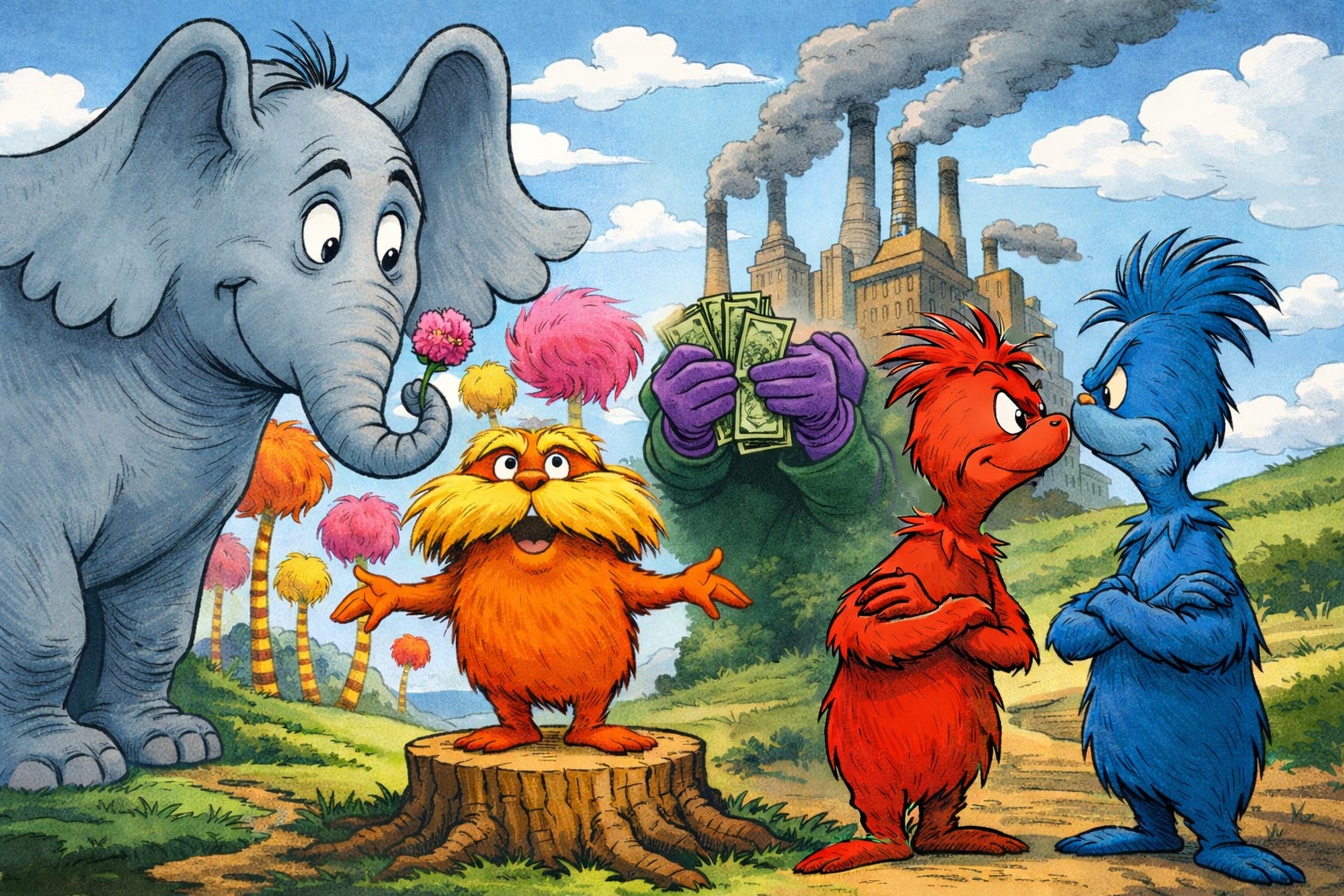
Dr. Seuss is a national treasure not because he wrote children’s books in rhyme, but because he disguised societal diagnostics as children’s stories.
Over the past month, I’ve written about Horton, the Lorax, the Once-ler, and the Zax. It’s been a nostalgic journey back to my own childhood and to the nights I spent reading to my kids at bedtime.
The choice of Dr. Seuss was deliberate. I’m a simple man and enter the world through metaphor. His timeless wisdom is a relatable entry point into ideas I’ve been wrestling with intellectually and professionally for more than thirty years. Those ideas culminated in an unpublished book that currently lives on my hard drive and in the cloud. You can never be too careful.
In week one, I used Horton to talk about the importance of listening and connecting action to what we hear. I followed with a piece comparing former Intel CEO Craig Barrett to the Lorax, warning Congress that the country isn’t producing enough engineers to keep pace in the 21st century. I connected the Once-ler’s warning of unless to the fragility of democracy revealed by the events in Minneapolis.
Finally, I used the Zax to illustrate that global progress doesn’t stop simply because the United States Congress is paralyzed. China’s lead in electric vehicles and Taiwan’s dominance in semiconductors illustrate the compounded damage from generations of policy paralysis in education, immigration, and public sector investment.
Over a nearly forty-year career and more than a million miles of travel, I’ve seen a pattern repeat that the Seuss framework crystallizes. Other than the New York Jets, most organizations don’t fail because of inept leadership. Most institutions fail because they can’t act on what they already know.
NASA engineers knew it was too cold to launch Challenger. Boeing engineers knew MCAS on the 737 MAX was flawed. Generals, cabinet secretaries, and presidents knew for twenty years that the war in Afghanistan was failing. Intel recognized that mobile posed an existential threat to the dominance of the PC microprocessor. A generation later, it knew that the RISC architecture behind NVIDIA’s chips was better suited for the massive parallel processing required by artificial intelligence. Today, NVIDIA is among the world’s most valuable enterprises.
These examples aren’t hindsight or Monday-morning quarterbacking. In every case, the warnings existed in real time. Successful organizations led by brilliant people failed to act on information they already possessed, developing peripheral blindness that obscured threats obvious in hindsight. Catastrophic failures are not black swans. They are often the predictable result of an inability to synthesize and surface information and conclusions that already exist.
This phenomenon stems from three disparate but interconnected mechanisms: synthesis failure, misaligned incentive structures, and institutional capture. Together, these mechanisms form what I call The Loop and create fertile ground for institutional failure.
The Loop is not linear. These mechanisms reinforce one another continuously, shaping what information is surfaced, which risks are tolerated, and which truths are safe to acknowledge. Over time, candor erodes, inertia dominates, and leaders benefit from protecting and maintaining the status quo even as indisputable evidence of failure accumulates.
Over the next several weeks, I’ll drill into the causes of The Loop and the techniques leaders can use to recognize and break it inside their own organizations. Once you learn to see The Loop, you can’t unsee it. Learning to recognize it unlocks powerful tools for breaking it. Five specific mechanisms that can transform organizations through strategic alignment, information flow, measurement, time horizons, and authority
.
Postscript: If you know a literary agent or publisher who might be interested in this work, I’d welcome an introduction. Thanks.