

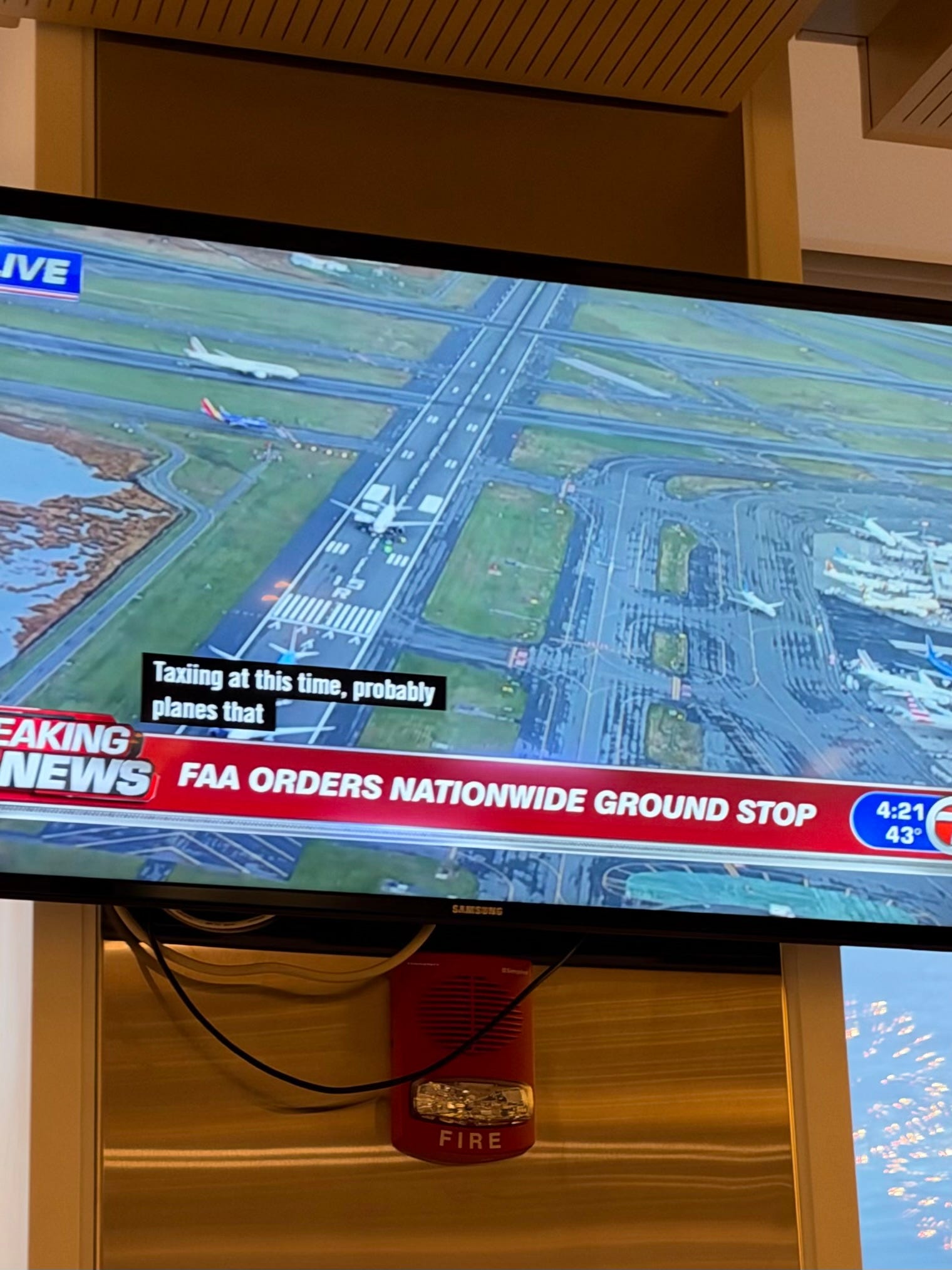
I walked into the United Club at Logan on Friday afternoon. Every guest at the lounge was crowded around the bar watching the CNN. The news was ominous. Jake Tapper was informing a room full of frequent flyers in one of the nation’s busiest airports that the FAA had just halted all departures in the United States.
We all knew the drill. Don’t panic. Thunderstorms, maintenance issues, crew shortages, overbooking. We’ve all been stranded before and knew that anger, panic, and blame were fruitless. I checked Amtrak. No seats for that night’s two remaining trains headed to New York. Clearly, I was late getting the news and the other travelers had beaten me to the Acela. I called my wife, told her not to expect me at my scheduled arrival time. My mother called as soon as she saw the news and was already laughing when she said, “Let me guess, it’s Friday night and you’re in an airport.”
I texted my other weary traveler friends. The sentiment was unanimous. We were screwed and there was no chance of taking off that night unless we were headed across the Atlantic from the East Coast or across the Pacific from the West Coast. The smart move would be to rent a car or get a hotel room. I rented a car and headed south. The drive with traffic was only 7 or 8 hours. I could theoretically get home that night. I didn’t. I gave up around Newtown, Connecticut when my age, the full week of work, and the late hour caught up with me.
I suspect that a reality star discovered, a few minutes earlier, that he might have the worst job on earth. No, not that guy. The other one, the former professional lumberjack from MTV’s Real World: Boston, who finds himself in charge of a significant portion of the nation’s creaky infrastructure with insufficient funding to fix most of the documented problems across his broad portfolio.
Friday’s crash of the air traffic control system should not come as a surprise to any member of the traveling public and most likely was not a surprise to the guy with the worst job on earth. The FAA is phasing out floppy disks and hopes to be complete by 2028. Modernity is still a long way off.
Friday was a warning shot. More frequent stoppages in the air traffic system are not beyond the realm of possibility. The FAA is in the process of upgrading the system; right now they are holding it together with chicken wire and chewing gum. Anyone who regularly flies in and out of Newark can tell you of the frequent air traffic issues that cause delays on both departures and arrivals.
The air traffic system is the tip of the iceberg. The nation’s bridges and tunnels are falling apart. The passenger rail system is primitive and inadequate. Rail traffic across the Hudson River into the nation’s largest city is dependent on two bores of a one- hundred year old rail tunnel that was severely damaged during Superstorm Sandy.
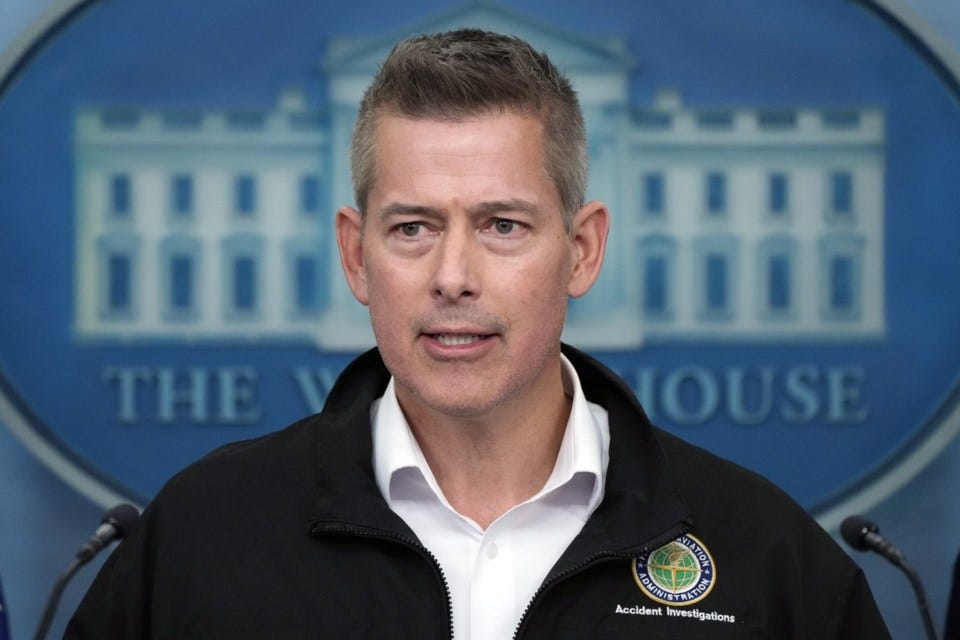
I’m not blaming Secretary Duffy for Friday’s ground stop or any of the other problems. He’s the former congressman who moves into a Georgetown fixer-upper and discovers that the bathtub fell through the ceiling into the kitchen when he comes down for breakfast the next morning.
We’ve spent 50 years neglecting the air traffic control system and it’s not a surprise that it failed, stranding millions of travelers on a Friday night. We avoided disaster only because of the professionalism and training of the air traffic controllers and air crews who managed to get everyone on the ground safely despite antiquated technology. They should be applauded for following protocol despite greatly degraded communications capabilities.
Transportation is far from the only neglected system in the United States. Deferral, avoidance, and denial appear to be the norm in Washington and have been for decades. Operation Warp Speed proves that we can make tough decisions and execute flawlessly in a crisis. General Gus Perna, Moncef Slaoui and their teams harnessed our scientific and industrial might in response to COVID-19, shrinking the vaccine development timeline. A process that normally takes 10-15 years went from lab bench to shots in arms in less than a year.
We know that the Social Security trust fund is heading for insolvency by 2032 and have done nothing. The same holds true for the Medicare trust fund which will be depleted by 2033. Our approach seems to be to acknowledge a problem, argue about it, do nothing, and blame the previous administration.
We’re at a crossroads, a time when institutional competence is imperative. We face generational problems that will require contentious decisions, political compromise, and disciplined execution. We are out of time. We can no longer avoid the problems and blame the other guy. A divided government brings us to a fork in the road. One fork takes us to compromise and holds both Congress and the Executive accountable for addressing the intractable problems facing the country. The other fork takes us to continued gridlock until the next crisis forces action.