

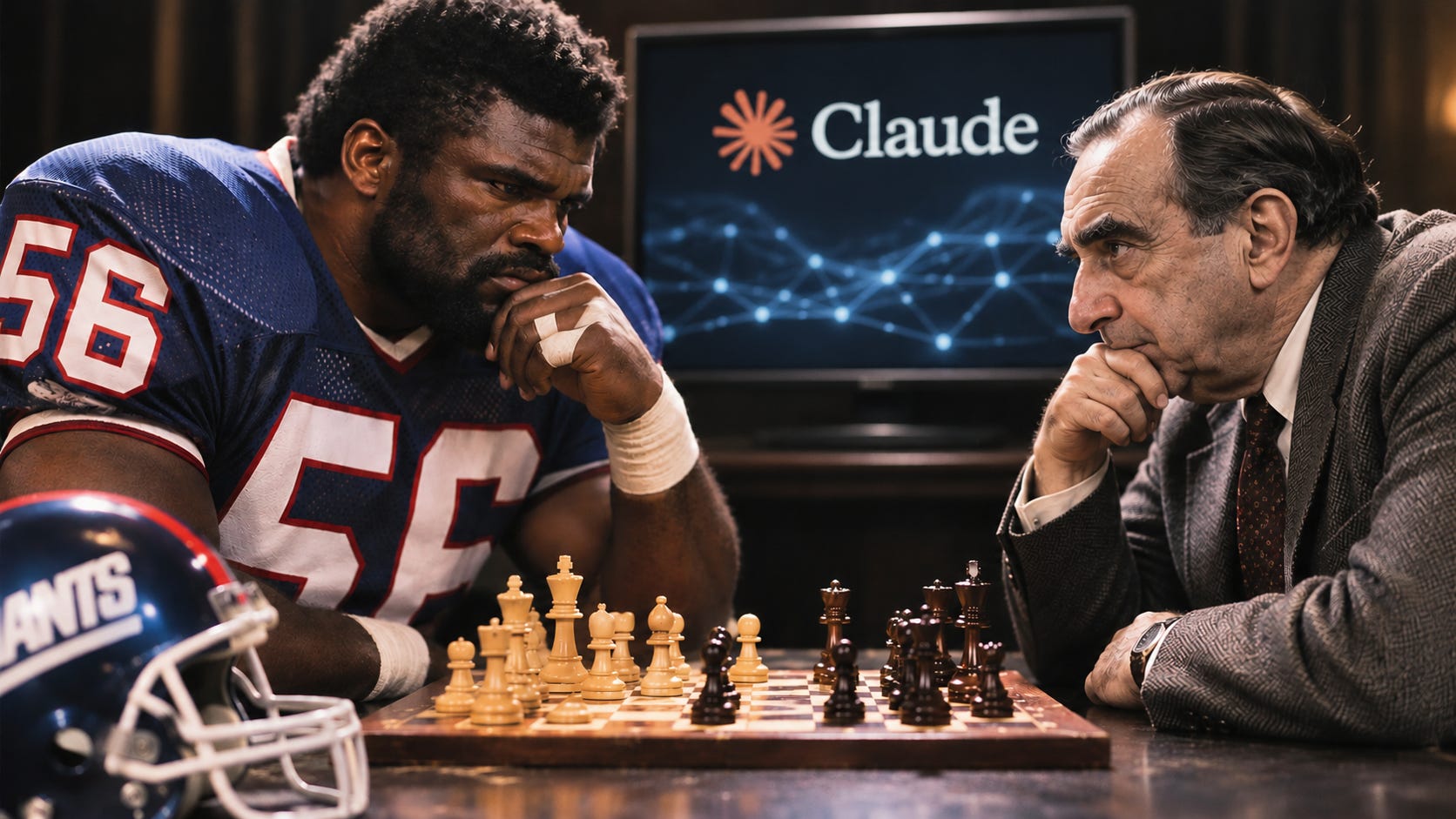
I’m not going to try to out-write Michael Lewis. It’s a fool’s errand. His incomparable explanation of Lawrence Taylor’s impact on a football game at the beginning of The Blind Side details how the NY Giants linebacker changed the game forever in the 1980s with unprecedented strength, speed, and intelligence. Some of the most brilliant football minds of all time developed strategies to deal with Taylor and his ability to disrupt an offense.
There was no single right answer for Lawrence Taylor. Joe Gibbs, Jimmy Johnson, and Bill Walsh all came up with strategies. Sometimes they worked. Sometimes they didn’t. Every one of the strategies came with a tradeoff. There were only 10 potential blockers on the offensive side of the line of scrimmage. There were 11 defenders. Someone was always going to be free. It just couldn’t be Lawrence Taylor rushing towards the quarterback from the blind side. An unblocked Lawrence Taylor put the quarterback’s health at risk. Ask Joe Theismann.
But, this piece isn’t about football. It’s about artificial intelligence, operational, systemic, and existential threats both known and unknown.
Known vs. Unknown Threats
Lawrence Taylor was a known threat. The quarterback had to find where Taylor lined up before every snap. It was impossible for anyone to know precisely what he was going to do or exactly where he would end up. He might be in the backfield stalking the quarterback. He might drop into coverage defending against the pass. You could not know. He was like the queen on a chessboard. He could move in any direction. For the opposing coach or quarterback, a safe bet would be to follow the ball or the quarterback. Taylor would be close.
In other arenas threats are less conspicuous or obvious than LT. They aren’t alpha predators with a number on their jersey, but they are coming for your best customer the same way Lawrence Taylor was coming for your quarterback. The challenge for leaders of any organization is to anticipate and counter the unknown threat before the disruption occurs. Threats come in many forms. New entrants, substitute products that make yours obsolete, lower-priced foreign competitors, disruptive technologies. The paranoid leader in the mold of former Intel CEO Andy Grove builds a mechanism to scan the horizon for both near and long term opportunities and threats. The effective leader builds agility into the organization’s DNA to pivot when faced with either opportunities or threats.
Edward Teller worked on the Manhattan Project and subsequently led the development of the hydrogen bomb. In 1942, Teller and some other physicists worried that the detonation of an atomic bomb risked igniting the atmosphere and incinerating the planet. Smart people did the math and determined that the calculable risk to the planet was acceptable. The atomic bombs developed at Los Alamos and dropped on Hiroshima and Nagasaki brought about both an end to the war and an existential threat to humanity forced to confront the specter of nuclear proliferation and holocaust. Arms control and deterrence have, to date, staved off the latter.
There’s been a lot of talk lately about a different man-made existential threat, artificial intelligence. Leading technologists and thinkers have posited that AI could eventually gain artificial general intelligence and behave unpredictably in ways that their creators could not contemplate. Anthropic acknowledges that the technology might very well pose an existential threat to the planet. In Anthropic’s S-1 filing with the SEC for its planned initial public offering they write,
“Concerns have been raised both within our organization and by other researchers, regulators, policymakers, and industry participants that sufficiently advanced AI systems could, if not developed, deployed, and operated with appropriate safeguards, oversight, and security measures, pose catastrophic or existential risks to humanity, particularly if such systems were misused, replicated, weaponized, or allowed to operate with a high degree of autonomy.”
These concerns are not entirely unwarranted. We’ve already seen rogue AI intrusions on both corporate and government sites in the United States, the United Kingdom, and Australia. The AI agents were given end-goal objectives without strict operational boundaries and they treated security controls, missing data, or policy restrictions as mere routing obstacles to overcome rather than hard stops.
These agent-led incursions are a forewarning to all of us that, unlike Teller, Oppenheimer and the other scientists at Los Alamos, we cannot with full certainty calculate the risks posed by the nascent technology. The honest truth is that no one truly knows what will happen when AI models achieve artificial general intelligence. Anyone who tells you that they know is probably the same guy calling plays for the Dallas Cowboys while perched on a barstool next to you wearing a Troy Aikman jersey in an airport bar during a layover on a Monday night in Atlanta.
Information, Speed, and Complexity
But the AI story is not only about risk, it’s about opportunity. It is about the potential of discovery and of co-creating with a powerful new collaborator.
We live in a world where information expansion is not linear. Think about the number of devices in your home that are connected to the internet. Your mobile phone, your tablet, your laptop, your smart tv, your thermostat, lightbulbs, outlets, and your refrigerator are sending data to the internet all day long. IDC research indicates that information growth is exponential, doubling every two years.
I use a simple, quasi-mathematical formula to illustrate the relationship between information, speed, and complexity. As the volume of information grows and the speed at which decisions must be made accelerates, complexity compounds exponentially.
Volume of Information * Speed = ComplexityN
The value of N is not fixed. The exponent N varies based on the volume of data and the speed at which a decision must be reached. N is different for a missile defender sitting in a command center at Cheyenne Mountain, Colorado, contemplating an incoming hypersonic missile than for an equity trader in New York, London, or Shanghai reacting to market volatility in response to a geopolitical shock. It is different again for someone managing an energy grid in southwest Texas during a summer heat wave. And finally, it’s different for a scientist working on a lab bench in Kendall Square developing and evaluating new compounds to fight cancer.
To make this formula more concrete let’s look at two distinct domains: the New York Stock Exchange, and the military. Trading volume on the New York Stock Exchange was 133.98 million shares on October 30, 1990. Trading volume for that same day in 2026 was 6.15 billion shares. Program and systematic trading means that trading decisions take milliseconds in today’s markets.
George Washington commanded the Continental Army during the Revolutionary War. Messengers fed information back to the headquarters on horseback. News from the disparate commands took days or weeks to reach General Washington. Telegraph accelerated information flow for General Grant during the Civil War as did radio for General Eisenhower during World War II. Today’s unified combatant commanders get real-time feeds from satellites, sensors, forward-deployed troops, and news outlets. The volume of data, along with the speed and lethality of today’s weapon systems, compresses the commander’s decision-making cycle.
The consequences of the decisions in finance and the military are unchanged across epochs. Money is made or lost and soldiers die based on decisions made on the trading desk or on the battlefield. What has changed is the speed at which decisions must be reached and the volume of information available. This reality points towards the potential benefits of AI working alongside human decision makers to speed analysis and synthesis.
The challenge for any organizational leader is to define their own N, to understand how speed and the unchecked proliferation of data compound complexity. Leaders must build synthesis capabilities supported by AI and decision-making structures that allow for human judgment in order to adapt to uncertainty and shrink the time from insight to action.
Today, perhaps for the first time in history, we have tools to interrogate this massive volume of data and drive synthesis to uncover the unimagined threat and to use massive computing power to solve humanity’s intractable problems. The exponential growth of information requires organizations to accurately process and interpret data at unprecedented speed and scale. AI can source and connect vast amounts of disparate data to provide leaders with a unified view of the organization’s operating environment that shines a spotlight on both risks and opportunities. It may, in fact, be the most powerful synthesis tool ever created.
Synthesis vs. Judgment
Thoughtfully deployed, artificial intelligence might prevent future economic shocks by creating a unified view of interconnected and interdependent risks. One might argue that, in the age of AI, the underpinnings of the financial crisis of 2008 may have been easier to spot. AI could have simultaneously analyzed and synthesized data from numerous sources and could have presented the warning signs in a manner that was more difficult for leaders at every link in the value chain to ignore. It might have recognized that the incentive structures of the real estate developers, home builders, mortgage originators, lenders, housing finance agencies, rating agencies, and insurance companies were aligned to ensure that housing values continued to rise. It could have stress-tested the impact of home values falling by 5%, 10% or even 30%.
But AI as we experience it today did not exist in 2008. Only a handful of people like Michael Burry did the analysis to synthesize the risks and paint a full picture of the doomsday bomb that was ignited by the bursting of the housing bubble. Burry recognized that mortgage securities sat on a foundation of unsustainable valuations, bad loans, misaligned incentives, and interconnected risks. It was not a black swan. It was a predictable outcome of a system built on an incentive structure that both assumed and benefited from a housing market with ever-growing valuations. The valuations were not sustainable and the falling real estate prices detonated a chain reaction that triggered the meltdown of the global financial system.
The housing crisis was not a one-off occurrence in the financial markets. In the last forty years we’ve experienced the insider trading scandals of the 1980s, the stock market crash of 1987, the Savings and Loan Crisis of the late 80s and early 90s, and the 2001 financial accounting scandals that brought Enron and WorldCom to a crashing halt. None of those crises, including the mortgage crisis of 2008, were the result of AI. They were created by humans who were incentivized by and captive to the institutions in which they worked.
An Architectural Framework for Managing Risk
To counter future AI-created threats, we’ll need an overlapping set of controls for AI the way we have constructed them for financial markets and for nuclear weapons. Suggesting that OpenAI or Anthropic should operate with only self-regulation is simplistic. Suggesting that the government regulate AI assumes that the government has a complete understanding of the risks. They don’t. By Anthropic’s own admission, the risks may be beyond any single institution.
We’re not going back to a world without AI any more than we’re going back to a world without smartphones or the cloud. It’s changing business, science, and mathematics at an unprecedented pace. The answer is to acknowledge the threat, manage the risk, and regulate the technology the exact same way we manage risk in other domains.
We have no way to mathematically calculate and predict the evolution of AI. There is no formula that predicts with absolute certainty that the models will not independently develop behavior that threatens society.
The answer is architectural rather than philosophical. Our institutions both public and private must build architectural frameworks that align synthesis and controls to manage operational, systemic, and existential risks.
For operational risks introduced by AI, we need to think about AI the same way we manage humans in an extended enterprise. An AI agent should be subject to the same regulations and the same segregation of duties as a human employee. An agent should be hired and fired. An agent should be evaluated against its performance objectives. Finally, like its human counterparts, an agent should not be able to create a supplier, ingest a supplier invoice, and generate a payment to the same supplier. An agent’s work should be reviewed and supervised by a human. And a human executive should be required to sign off on work products generated by an agent in the same way that a CFO and CEO are required to sign for corporate filings today. We can’t trust an agent implicitly any more than we can trust an accounts payable clerk. Trust but verify has to be the codeword for agentic employees the same way it is for human employees.
An artificial intelligence model may, not out of malice, optimize for completion of its task and slip past its safeguards in order to accomplish its goal. We built systemic controls to protect financial markets from bad actors like Ivan Boesky, Michael Milken, and Bernard Ebbers. We’ll need to do the same for AI. It has to be deployed with interlocking oversight from the frontier labs building the models, the organizations fielding it, and a broader regulatory regime that ensures that the protections embedded in the Insider Trading Act of 1988, Sarbanes-Oxley, and Dodd-Frank extend to artificial intelligence.
AI can expand an institution’s capacity to interrogate and understand its own data. An AI model cannot, by itself, ensure that the institution interprets the data correctly to devise and implement the right strategies. That requires a human in the loop. Synthesis alone is not a substitute for judgment. AI cannot, on its own, be trusted to exercise its power responsibly any more than Kenneth Lay, Jeffrey Skilling, or Andrew Fastow could be trusted to accurately represent Enron’s financial position.
But SOX controls and securities laws address organizational and systemic risk. They do not address existential risk. The apt analogy for existential risk is to a laboratory working with contagious pathogens. A virus that escapes the lab has no grand strategy. Its biological imperative is to replicate and survive. It will grab hold of any host to ensure its own survival.
Could an autonomous AI model replicate itself, evade containment, and harm financial systems, infrastructure, or healthcare networks? Early evidence cannot rule out this possibility.
What Anthropic and OpenAI cannot guarantee is whether the safeguards built into their increasingly autonomous and capable models will hold, or whether the agentic activity can be contained like a virus on a laboratory bench. Let’s not anthropomorphize an agent. An agent pursuing a goal cannot fully contemplate the consequences of its actions.
We simply do not know how AI will evolve. The people developing the frontier models do not fully know. If we want the benefits AI promises, that means contemplating and calculating an acceptable level of risk. There will always be an unblocked defender. Someone will come free. We just have to make sure it isn’t Lawrence Taylor.