

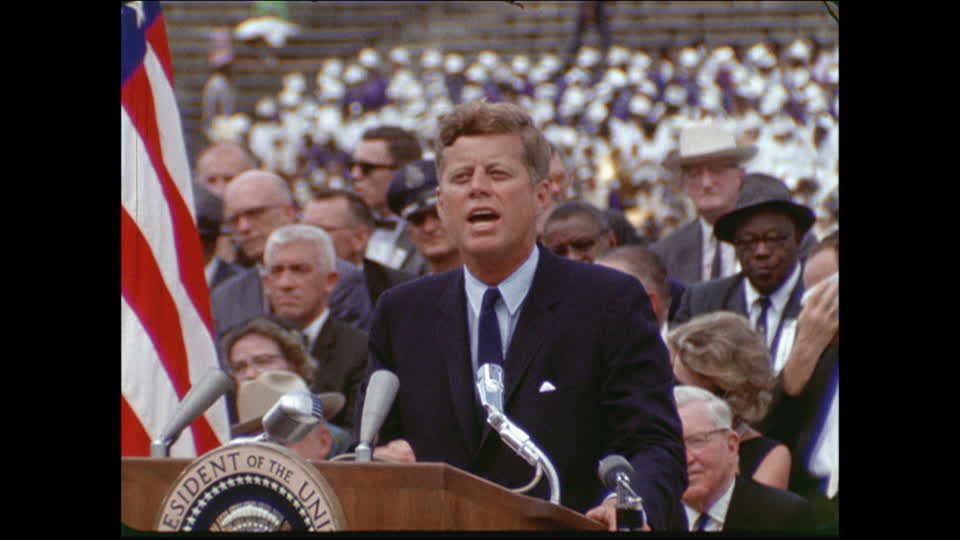
President Kennedy planted the seeds of the Apollo program when he proclaimed our intention of landing a man on the moon by the end of the decade at Rice University in 1962. He didn’t know how we’d get there, how we’d get back, or how we’d pay for it. He had people for that.
Neil Armstrong never plants the flag on the moon without the engineers, scientists, and flight controllers working across an extended enterprise inside an architecture of competence that adhered to timelines, solved technical challenges, and continuously adapted in service of the Apollo mission.
This architecture is deliberate and repeatable. It structures an organization to focus on the mission, synthesize data, measure progress, and adjust strategy based on what the data says.
These five structures, North Star, Hub, Scoreboard, Clock, and Throttle, don’t only apply to moonshots. They apply to your business, the community organization you lead, and even your career.
Kennedy’s statement: “We will go to the moon by the end of this decade” is the perfect articulation of strategic intent. It established the mission, the timeline, and pointed the entire country toward a clearly defined goal. It wasn’t the ambiguous fluff we see in corporate mission statements that proclaim an organization will be the best widget maker in its industry. It was a North Star every scientist, engineer, and American could understand. More than sixty years later, it still stands as one of the boldest declarations of national ambition ever spoken by a chief executive.
James Webb, NASA’s administrator, built a program office that coordinated more than 400,000 people across 20,000 companies, universities, and government agencies. NASA was the Hub for synthesizing information, assembling teams, and allocating resources in service of the overarching mission.
The next two mechanisms are the Clock and the Scoreboard. For Apollo, they were simple. Land a man on the moon and bring him home safely before the decade ended. The clock was fixed and public. Every American knew the deadline.
Can you say the same for your team? Do your people understand the organization’s North Star? Do they know what success looks like? Do they understand how today’s work connects to tomorrow’s mission?
Progress in complex systems is never linear. Apollo moved forward through breakthroughs, setbacks, and tragedy. After a catastrophic fire killed the three astronauts aboard Apollo 1, NASA halted the program, reassessed the command module, redesigned safety and evacuation procedures, and corrected underlying engineering flaws because crew safety was paramount. Sometimes slowing down is the key to going faster.
That is the function of the Throttle. It sets the pace of investment, creates onramps and offramps, and gives leaders the ability to accelerate, pause, or terminate initiatives based on evidence rather than inertia. The practical question is simple: who has the authority to accelerate investment, slow it down, or kill an initiative entirely? And are the decision criteria clear to everyone involved?
As we look forward to the six moonshots I outlined last week, the question is whether we have the architecture of competence to actually accomplish them. Do we have the North Star, Hub, Scoreboard, Clock, and Throttle to solve the entitlement solvency crisis, build high speed rail, and provide healthcare to all Americans?
Because moonshots are never limited by ambition alone. They succeed or fail based on whether institutions can transform intent into execution.