

I went to nursery school, elementary school, junior high school and then high school. I even, begrudgingly, went to Sunday school. I went to college. I went to Airborne School, the Armor School, and the Scout Platoon Leader’s School. Then I went back to grad school. Admittedly, I know nothing about school. I certainly know nothing about school in the era of artificial intelligence or how it will change the classroom.
I do know that education is the key that unlocks the door to opportunity for every child in every zip code. Not everyone needs to study Kant. Not everyone needs to study Plato. Not everyone should be forced to read the utterly incomprehensible novels of William Faulkner like I was. And, oh, Professor Wilson, if you are reading this, I couldn’t finish the Sound and the Fury. I tried.
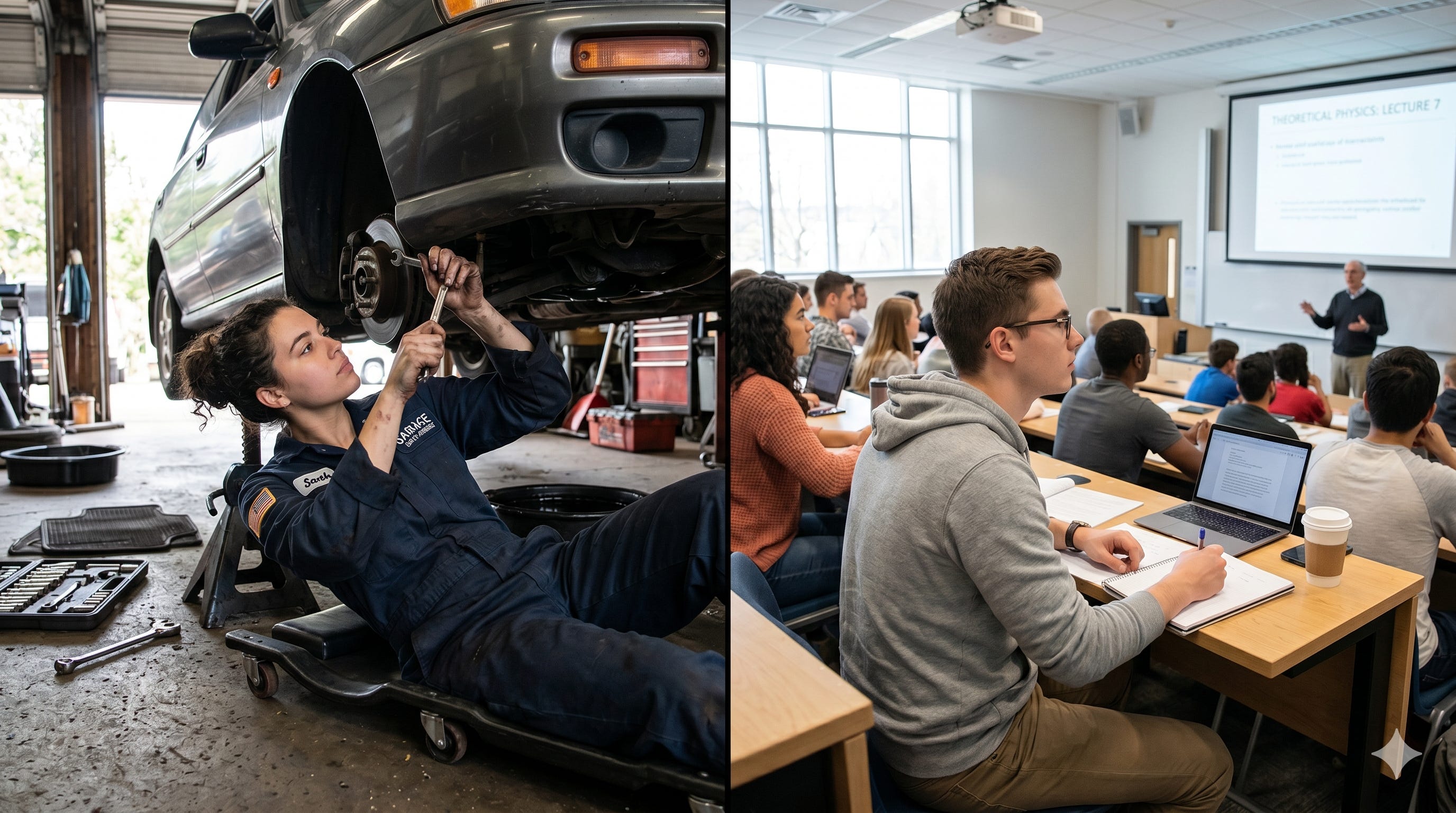
Some people need to learn how to thread pipe, run wire, and build roads. Others need to learn how to clean teeth, run MRI machines, and make a perfect sous vide chicken breast. There are schools for all of that. There are kids who find their passion in a lab, kitchen, or behind the wheel of an 18-wheel truck. Their contributions are every bit as valuable as a banker, accountant, or teacher.
Every moonshot starts with architecture. The structure that takes the idea from the drawing board to small steps and giant leaps on the lunar surface. The ability to assess what’s working and what’s not. The technical knowledge paired with the grit and determination necessary to solve the hard problems that make landing on the moon possible.
The North Star should not be a four-year degree for every kid. Some kids would rather turn the wrench underneath the chassis of an Audi than sit in a lecture hall exploring demand curves, Freud, differential calculus, or iambic pentameter.
The North Star for education is simple: help kids find what they are good at, what they love, and give them a path to turn it into a productive life.
We don’t have a monolithic education system in this country. There are over 13,000 school districts spread across cities, towns, and counties. Depth of opportunity is largely rooted in geography. Kids in rural Mississippi and kids in New York City suburbs who have exceptional aptitude in mathematics should have the same opportunities.
Geography is not destiny. Not any more. Not if affordable broadband reaches every corner of the country the way the TVA brought electricity to Appalachia during the 1930s. Not if that broadband streams AP courses and instruction to neglected hamlets, boroughs, and inner cities.
Genius is evenly distributed. Opportunity is not. Abe Lincoln learned to read by candlelight in a log cabin in Kentucky. Who knows, the next Lincoln might be learning on a tablet in a cold water flat in St. Louis.
The Hub for education goes beyond synthesis. It aligns pathways of opportunity with evolving national needs. It’s about ensuring that kids get matched and guided into programs that build on their skills and passions. That means equipping kids with mathematical, analytical, scientific, and mechanical skills while recognizing that athletic, artistic, and musical gifts matter too.
The hub also has to measure what matters. Race to the Top and No Child Left Behind measured test scores as if the test were the final score. They weren’t. A sales manager who tracks calls made instead of deals closed is measuring activity, not outcome. The same logic applies to education. Test scores tell you what happened in the classroom. Employment outcomes tell you whether any of it mattered.
The federal government shouldn’t run every classroom in America, nor should it dictate the curriculum to every school district. But it should know which welding program in Ohio is producing skilled tradesmen, which math program in Mississippi is creating engineers, and which nursing pipeline in Arizona is actually putting nurses into hospitals five years later.
The Department of Education cannot operate in isolation. Every cabinet department depends on the workforce the education system produces. The future engineers at NASA, the cyber specialists at NSA, the welders in the Navy’s shipyards, and the nurses at the VA all come out of the same pipeline. If we understand what the country needs, we can build an education system designed to produce it.
The military has long understood this. The service academies and ROTC programs create a talent pipeline that transforms promising high school students into field grade and general officers twenty and thirty years later. The same needs exist in the civilian world. Teachers, physicians, nurses, welders, cyber analysts are critical skills that deserve the same strategic investment as field artillery and quartermaster officers.
The Scoreboard and Clock are essential. If we align the Scoreboard and Clock to the North Star, we shift measurement from graduation rates to employment outcomes three, five, and ten years after graduation. Schools that prepare kids for productive lives should be measured on that metric.
Innovation, by its very nature, is iterative. A throttle that accelerates investment into what works, and kills programs that don’t. Spending more money on programs that don’t produce results is bad management, bad policy, and bad government.
Education is not a social welfare program. It is a national development strategy. The goal is not to push every child toward the same credential, but to build a system that identifies talent early, develops it honestly, and converts it into productive work. That is how you grow the skill base, grow employment, and grow the tax base. That is how a moonshot goes from launchpad to touchdown.
I graduated as an Electrical and Electronics Engineering Technician and Industrial Instrumentation Technician. (British system). My other half has a BSc in Chemistry and a Masters of Education.
We have 3 boys (21, 18 &16) going to school in the US. While their Mom pushes the academic agenda, I have 3 main criterion for them:
1. Somewhat AI proof
2. A possible path to starting a business in that direction.
3. You think you will enjoy it.
The oldest is a pilot and flight instructor building his hours.
The 2nd, absolutely hates studying. He’s going to start trade school to learn industrial refrigeration.
The 3rd seems to like Mechanical Engineering and robotics. He’s thinking about weapons design.
The US has better possibilities for them than anywhere else on earth. Let’s hope it works out for them. 🤓