

Quick, who won last year’s Super Bowl? The Stanley Cup? NBA Championship? The World Series? Unless you live in Seattle, Florida, Oklahoma City, or Los Angeles you probably can’t remember. I couldn’t either, I had to look it up.
The winning teams are not the point. Sports are one of the last few things that unite the country. Things that we watch at the same time in a sports bar or in our living room. How many team calls last week started with did you see Rory putt with his back to the hole on 16, or congratulating Connie from marketing for winning the company NCAA bracket pool? Despite the tribal rivalries between Michigan and Ohio State, Bears and Packers, or Yankees and Red Sox they provide a common prism through which we can experience the world.
It’s for that reason that the integrity of the games matter.
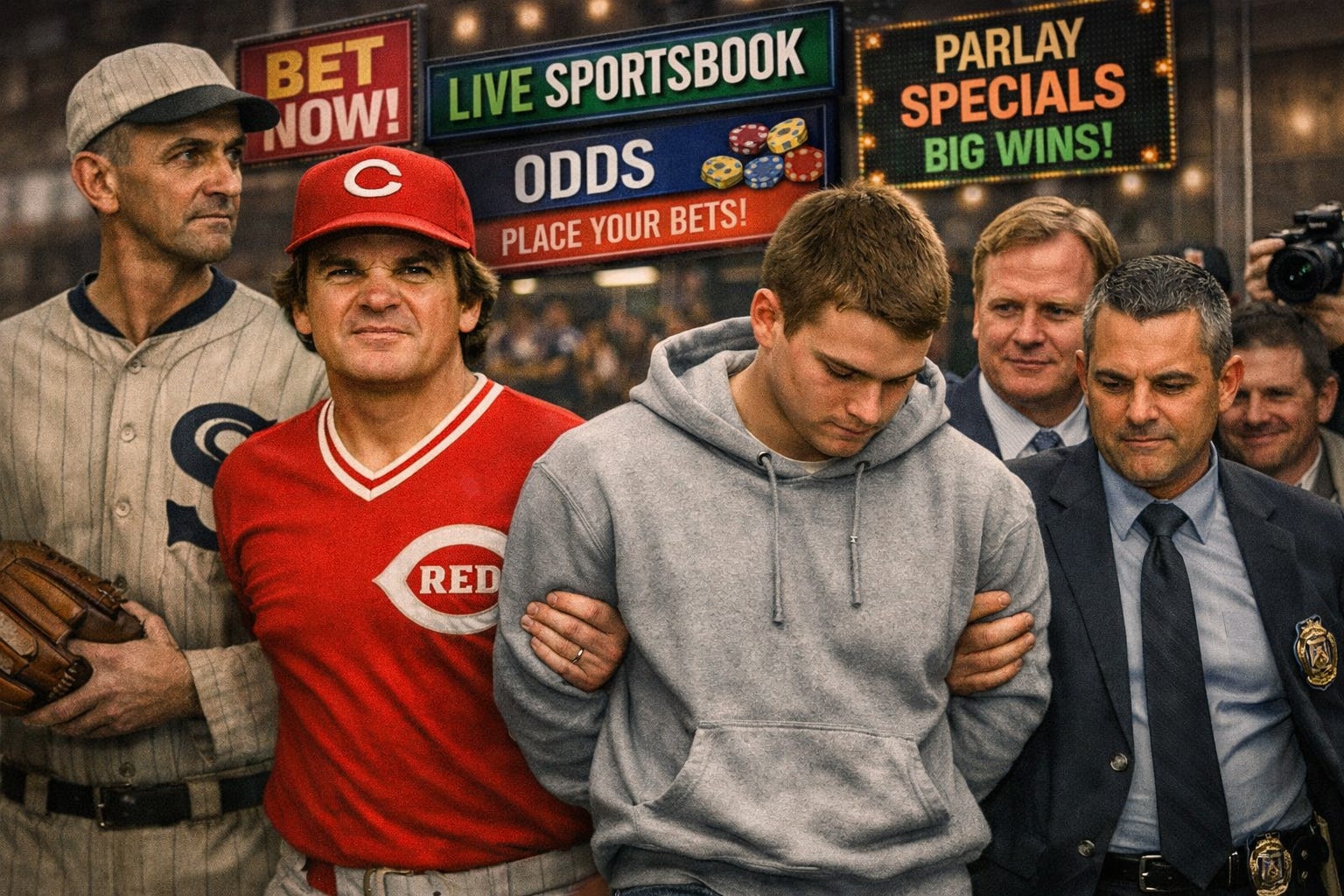
Shoeless Joe Jackson didn’t always live in a corn field in Iowa. He was a real baseball player. In the 1919 World Series he hit .375 with 12 hits, a home run, 6 RBIs in 8 games. He led both teams in batting average and set a World Series record for hits that stood until 1964. Jackson, along with 8 teammates, was banned from baseball for throwing the World Series. Jackson professed his innocence for the rest of his life. According to urban legend, Jackson wandered sandlots across the country for the rest of his life in search of a game.
Pete Rose was a bully, a hypocrite, a gambler, and a tax cheat. He was also a giant of the game and collected more hits, 4,256, than anyone in the history of baseball. In 1989 commissioner Bart Giamatti banned Rose for life for betting on baseball.
Jackson and Rose faced baseball’s death penalty for violating baseball’s rule 21: There is no gambling on baseball. The signs were posted in every major league clubhouse.
Thirty-five years later the signs are still posted in the clubhouses in English, Spanish, and Japanese.
The Sell-Out
Look out from the dugout and FanDuel, DraftKings, and BetMGM have billboards in ballparks. Their ads blanket every local and national broadcast with spokespeople including: LeBron James, Kevin Hart, Jamie Foxx, Shaquille O’Neill, Charles Barkley, Kendall Jenner, and Vince Vaughan.
Disney owns BETESPN. In the ultimate act of corporate synergy Mickey and Donald may soon have a segment reviewing parlays and spreads for next week’s games on the Manning-cast on ESPN2 every Monday night during the NFL season.
The sports leagues didn’t change their minds about the original sin of gambling. They changed their minds once the money moved from the back alley to the internet.
The leagues decided to take the money from the legal sports books after years of looking away from Ralph the Rake, Benny the Bookie, and Sammy the Sharp. Honestly, the leagues would accept advertising revenue from Walter White’s Cook Shop and Deli if they were confident the check would clear. And why shouldn’t they?
The Scandals
What followed were the most predictable scandals in the history of scandals.
In November 2025, two Cleveland Guardians pitchers, Emmanuel Clase and Luis Ortiz, were federally indicted for taking bribes to throw specific pitches, balls in the dirt, so gamblers could win prop bets. Clase was a three-time All-Star building generational wealth as one of the game’s most effective closers. He was not a journeyman reliever on a league minimum salary.
Emmanuel Clase earned roughly $4.9 million in 2025. The betting scheme allegedly netted the gamblers he was working with $700,000 total across three years, with Clase receiving a few thousand dollars per game. In one documented instance he received $7,000 for a single rigged pitch. Bribe payments funded repairs on Clase’s country house in the Dominican Republic.
Clase was one of the most effective closers in baseball and inhabits a different financial sphere than the rest of us. $7,000 is .0014% of his annual salary. For Clase and his fellow big league stars, $7,000 is a tip for bottle service at the Bellagio. It’s immaterial, a rounding error.
That’s not greed. That’s what happens when you build a system that makes it frictionless to corrupt the product and then act surprised when someone does it. For its entire history, the league tried to keep gambling in the back alleys and phone booths in Bensonhurst. They banned Shoeless Joe and Pete Rose. They opened the floodgates when the money was too vast to ignore.
It’s not just baseball. The NFL, NBA, NHL, NCAA and PGA were there at the troughs too feeding on the cash the legal sports books infused into their sports.
In October 2025, the NBA had its own reckoning when Portland Trailblazer head coach Chauncey Billups and Terry Rozier were caught in the federal crosshairs. Billups, a Hall of Famer and sitting head coach, was allegedly acting as a “face card” for rigged, Mafia-backed poker games, while Rozier was indicted for trading inside information on his own injuries to fuel a $200,000 prop-betting ring.
Although the league suspended both Rozier and Billups, they were caught by the FBI, not by the league’s multi-million dollar integrity department. Twenty years earlier, referee Tim Donaghy bet on his own games for four seasons before the feds caught him too. The league didn’t find either one.
Want to know Roger Goodell’s worst nightmare? It’s not a work stoppage or a television ratings dip. A kick sails two feet right on a Thursday night game between the Jaguars and Cowboys. The Cowboys lose by 1 and don’t cover the spread. The guy hasn’t missed a short field goal all year, can you be sure the kicker’s on your side? Can Goodell? Can Jerry Jones?
The Big Con
When the sports leagues reversed course on sports gambling, after spending decades lobbying Congress to keep it illegal, the risks didn’t disappear. The money appeared. That’s the whole story. Commissioners and owners didn’t conclude gambling was safe. They concluded they wanted the revenue, and then built the case backward. They pointed to decades of regulated betting in Nevada while ignoring Tim Donaghy, Pete Rose, and the structural reality that a referee with a betting account and inside information is nearly impossible to catch in real time. The “integrity fees” they negotiated with states weren’t safeguards. They were the justification. The story that made taking the money feel responsible.
The Solutions and the Payback
We can’t put the genie back in the bottle. The revenue provided by the sports books from advertising and data syndication is too valuable to the leagues and to the teams. There are steps that can fix this, that can break The Loop and protect the integrity of the games. None of them require the leagues to give back the money. If the leagues are benefiting from exploiting the risks of the games, the players should be protected from the toll of the game.
The first and most urgent step is banning proposition bets. Clase didn’t throw a game. He threw some pitches in the dirt. That is the difference between prop bets and the Black Sox intentionally losing the World Series.
Prop bets don’t require a player to betray his team or abandon his competitive instincts in any meaningful way. He just has to bounce one ball in the dirt, run out of bounds a yard short, or miss a short putt in the opening round of the Waste Management. The psychological threshold is low. The money is immediate. The detection risk is minimal. A burner phone, an offshore encrypted text messaging service, a red flag in a flower pot on the balcony conceal the electronic bread crumbs. Prop bets are not a feature of sports gambling. They are a corruption delivery system, and the leagues know it.
The second step is to create a truly independent integrity commission, funded by a mandatory percentage of sports book revenues paid directly to the commission, not to the leagues. The distinction matters. The leagues have demonstrated they cannot police what they profit from. An arm’s-length structure, think independent inspector general rather than commissioner’s office, gives the commission both the resources and the jurisdiction to investigate and prosecute without asking permission from the people cutting the checks.
That jurisdiction must extend to college sports. The NCAA’s enforcement apparatus is a well-documented joke, and if the commission stops at the professional level, the corruption doesn’t disappear. It just migrates downstream to where the players are younger, less financially secure, and more vulnerable.
The commission should also fund treatment for sports gambling addiction. The sports books didn’t create problem gamblers by accident. They hired behavioral scientists to make their products as compulsive as possible. The leagues cashed the checks. Funding treatment isn’t charity. It’s the cost of doing business with an industry that monetizes addiction.
The third step is the one the leagues and the NCAA will resist most, because it forces them to look at what they have actually built. It will force them to confront the physical stakes of contact sports. The sports books didn’t create football or hockey’s gladiatorial combat. The gambling money just makes the economics of that bargain impossible to ignore.
NIL didn’t solve the labor problem. It gave the star quarterback a jersey licensing deal and called it equity. It didn’t do anything for the right tackle from Colorado State who was cut after his fourth concussion, never had an NIL deal worth mentioning, and walked away with nothing but exhausted eligibility and a medical history he’ll be managing for the rest of his life.
A portion of sports book revenues should fund pension, medical assistance, and CTE research programs that benefit both professional and college athletes. Not as charity but to reward their contribution to the multi-billion dollar businesses built from their labor. The leagues need to compensate and protect the players for sacrificing their bodies and brains so that we can place a three team parlay on Grambling, Indiana State, and Southern Illinois.
The professional sports leagues and the NCAA built a product on the physical destruction of the people playing it, cashed the gambling checks on top of it, and this fund is a step that simply balances the moral obligations with the physical hazard.
Sports matter. They matter because they unify us and create a shared experience. Clase was a warning shot. Throwing a game is the logical end state if we fail to protect the integrity of the games. At that point Roger Goodell, Adam Silver, and Rob Manfred might as well be Vince McMahon hitting opponents over the head with folding chairs. This is not a black swan. The warnings are hiding in plain sight. They always are.
Agree? Share it with a friend. Disagree? Share it with two.